
Consensus#
Overview#
Consensus is an AI-powered search engine designed specifically for scientific literature. Instead of just returning a list of papers, it synthesizes findings across studies to help you understand scientific consensus on a topic.
Website: https://consensus.app/
Key Features#
🤖 AI-Powered Synthesis: Automatically summarizes findings across papers
✅ Yes/No Questions: Get consensus on specific claims
📊 Evidence Quality: See study types, sample sizes, and limitations
🔍 Large Multidisciplinary Corpus: See their site for current coverage
📈 Consensus Meter: Visual indicator of agreement/disagreement
🎯 Direct Answers: No need to read 100 papers yourself
🆓 Free Tier: Basic use is free; advanced features have monthly limits
Getting Started#
1. Create an Account#
Visit https://consensus.app/ and sign up (optional for basic use, required for full features):
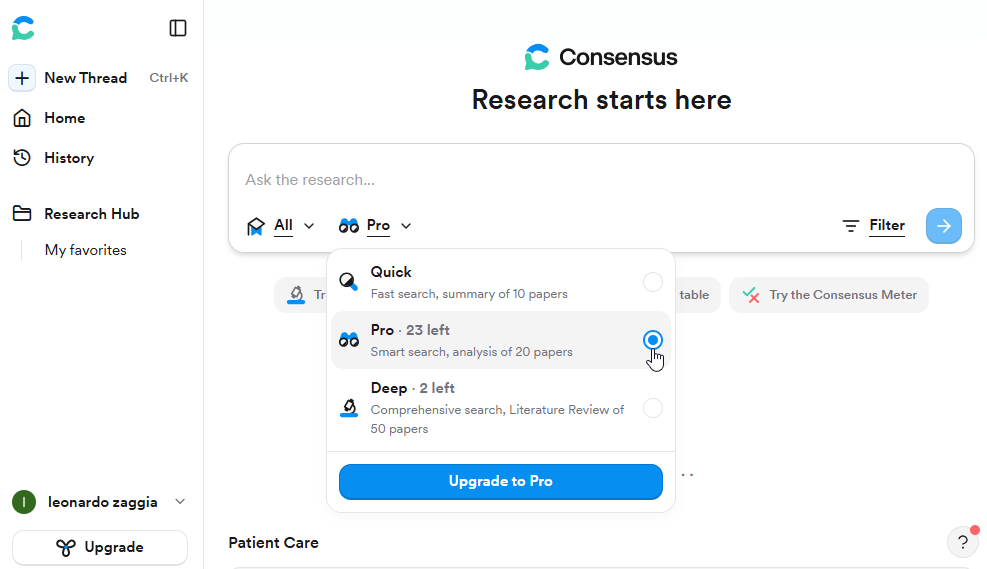
Free tier: a monthly allowance of advanced (“Pro”) searches
Paid tiers: more searches and advanced features
Plans change often - check consensus.app for the current limits.
2. Your First Search#
The magic of Consensus is in asking the right questions:
Good Questions (Yes/No format):
“Does exercise improve mental health?”
“Is intermittent fasting effective for weight loss?”
“Do transformers outperform LSTMs for NLP tasks?”
Also Works:
Open-ended: “What are the effects of caffeine on cognition?”
Exploratory: “machine learning healthcare applications”
Understanding Results#
Consensus Meter#
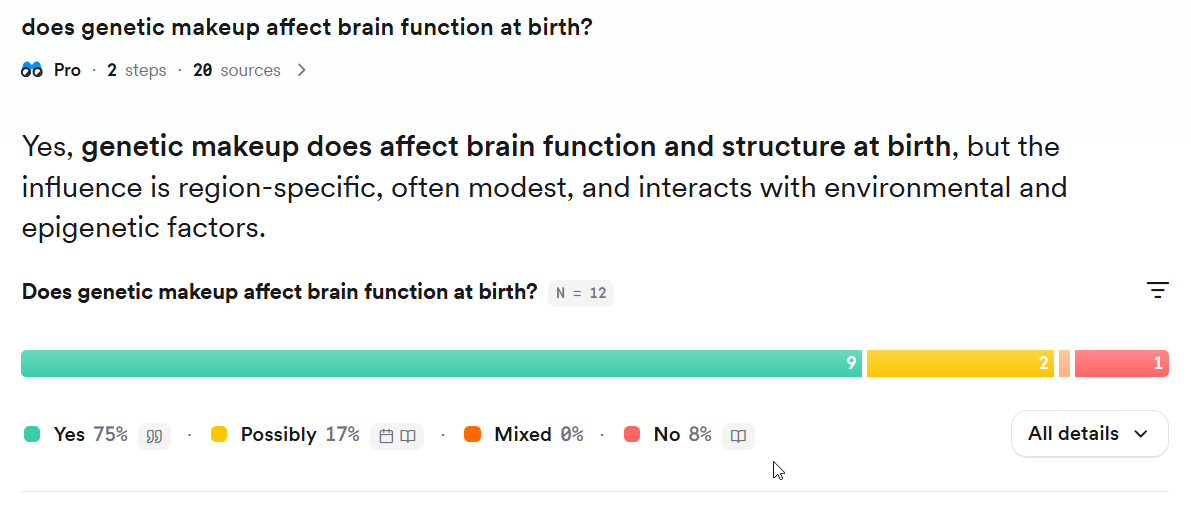
After searching, Consensus shows a visual meter indicating scientific agreement:
Paper Cards#
Each result shows key information:
Study Details:
📄 Title and authors
📅 Publication year
📊 Study type (RCT, meta-analysis, observational)
👥 Sample size
⭐ Citation count
AI Summary:
🎯 How this paper answers your question
📌 Key findings extracted
⚠️ Limitations noted
Evidence Quality Indicators#
Consensus helps you assess study quality:
Indicator |
Meaning |
Strength |
|---|---|---|
🥇 Meta-Analysis |
Synthesis of multiple studies |
Highest |
🔬 RCT |
Randomized controlled trial |
High |
📊 Cohort Study |
Long-term observational |
Medium |
📋 Cross-Sectional |
Snapshot in time |
Lower |
💭 Opinion/Review |
Expert perspective |
Context |
Search Strategies#
1. Yes/No Questions (Recommended)#
Best for evaluating specific claims or hypotheses:
✅ Good Examples:
- "Does vitamin D supplementation prevent COVID-19?"
- "Are convolutional neural networks better than transformers for image classification?"
- "Is cognitive behavioral therapy effective for depression?"

❌ Avoid:
- "Tell me about vitamin D"  (too broad)
- "Vitamin D and COVID"  (not a question)
2. Comparative Questions#
For comparing interventions, methods, or approaches:
- "Is drug A more effective than drug B for condition X?"
- "Do transformers outperform RNNs?"
- "Which diet is better for weight loss: keto or Mediterranean?"
3. Mechanism Questions#
Understanding how/why something works:
- "How does exercise affect mental health?"
- "What is the mechanism of action of metformin?"
- "Why do transformers work better than RNNs?"
4. Exploratory Searches#
Broad topic exploration:
- "machine learning drug discovery"
- "microbiome mental health"
- "climate change biodiversity"
5. Export & Citation#
Export Options:
📄 PDF reports with AI summaries
📚 BibTeX for reference managers
📊 CSV for data analysis
🔗 Shareable links
Citation Management:
# After exporting BibTeX from Consensus
# You can integrate with your workflow:

import bibtexparser

with open('consensus_export.bib', 'r') as f:
    bib_db = bibtexparser.load(f)

# Merge with other sources
papers = bib_db.entries
print(f"Found {len(papers)} papers with consensus support")
Practical Use Cases#
Use Case 1: Hypothesis Validation#
Scenario: You have a hypothesis for your research and want to know if there’s existing evidence.
Workflow:
1. Frame hypothesis as yes/no question
   "Does social media use cause depression in adolescents?"

2. Search in Consensus

3. Review consensus meter and paper distribution
   - 60% Yes → Strong evidence
   - 20% Maybe → Some uncertainty
   - 20% No → Contradictory findings

4. Click into papers for details
   - Sample sizes
   - Methodological quality
   - Confounding factors

5. Decision:
   - Strong consensus → Consider different angle
   - Mixed results → Opportunity to clarify
   - Little evidence → Novel contribution possible
Use Case 2: Literature Review Introduction#
Scenario: Writing the introduction to your paper and need to cite consensus.
Workflow:
1. Search key claims in your introduction
   "Machine learning improves medical diagnosis accuracy"

2. Consensus shows: 85% Yes (42 studies)

3. Export top papers to BibTeX

4. Write introduction with strong citations:
   "Recent evidence demonstrates that machine learning
    significantly improves diagnostic accuracy [1-5],
    with meta-analyses showing consistent benefits..."

5. Full bibliography ready from export
Use Case 3: Grant/Proposal Writing#
Scenario: You need to establish the importance and current state of research.
Workflow:
1. Significance Section:
   Search: "Is [problem] a significant health concern?"
   → Cite consensus studies

2. Innovation Section:
   Search: "Does [current approach] adequately address [problem]?"
   → Show gaps/limitations in existing solutions

3. Approach Section:
   Search: "Is [your proposed method] effective?"
   → Build on preliminary evidence
Use Case 4: Systematic Review Background#
Scenario: You’re conducting a systematic review and need to establish context.
Workflow:
1. Use Consensus for rapid background synthesis
   - Not for the systematic review itself!
   - Just for introduction/background sections

2. Identify key research questions

3. Design systematic search strategy

4. Conduct full systematic search (Review Buddy)

5. Screen papers systematically

6. Use Consensus to compare your findings with general consensus
Integration Example: are the papers Consensus surfaced also in your systematic search?
Search your question on consensus.app and export the results as
consensus_export.bib.Run the systematic search with Review Buddy:
python main.py --skip-download.Compare the two by DOI:
import bibtexparser
import pandas as pd

with open("consensus_export.bib", encoding="utf-8") as f:
    consensus = bibtexparser.load(f).entries
consensus_dois = {e["doi"].lower() for e in consensus if e.get("doi")}

papers = pd.read_csv("results/papers.csv")   # written by Review Buddy's step 1
search_dois = set(papers["DOI"].dropna().str.lower())

missing = consensus_dois - search_dois
print(f"{len(consensus_dois - missing)}/{len(consensus_dois)} Consensus papers found by the systematic search")
for doi in sorted(missing):
    print("  not found:", doi)
For every paper that is missing, ask why: date range, database coverage, or a query term your search lacks?
Tips & Best Practices#
Crafting Effective Queries#
✅ Do:
Use clear, specific questions
Frame as yes/no when possible
Include key terms and concepts
Consider synonyms and alternatives
❌ Don’t:
Use overly complex questions
Include multiple questions in one search
Use jargon without plain language alternatives
Expect perfect answers (AI synthesis has limitations)
Interpreting Consensus#
Strong Consensus (>75% agreement):
High confidence in finding
Multiple replications
Various study designs confirm
Moderate Consensus (50-75%):
General support with some uncertainty
May depend on context/population
Room for nuance
Weak/Mixed Consensus (<50%):
Contradictory evidence
Context-dependent effects
May indicate emerging area or complex phenomenon
Critical Evaluation#
⚠️ Remember:
Check Study Quality: High consensus from poor studies ≠ truth
Look at Sample Sizes: 10 studies with n=20 vs 2 studies with n=2000
Consider Recency: Fields change, older consensus may be outdated
Understand Limitations: AI summaries can miss nuance
Read Original Papers: For critical decisions, always verify
When to Use Consensus#
✅ Good For:
Quick background research
Hypothesis validation
Grant/proposal writing
Teaching and learning
Science communication
Exploratory research
❌ Not Ideal For:
Systematic reviews (use as supplement only)
Regulatory/clinical decisions (needs full review)
Novel/cutting-edge topics (not enough papers)
Very specific technical questions
Comparison: Consensus vs Traditional Search#
Feature |
Google Scholar |
PubMed |
Consensus |
|---|---|---|---|
Search |
Keyword |
Medical Subject Headings (MeSH) |
Natural language questions |
Results |
Paper list |
Paper list |
AI synthesis |
Consensus |
Manual analysis |
Manual analysis |
Automatic |
Speed |
Fast |
Fast |
Very fast |
Depth |
High (if you read all) |
High (if you read all) |
Medium (AI summary) |
Learning Curve |
Low |
Medium |
Very low |
Best For |
Comprehensive |
Medical research |
Quick synthesis |
Limitations & Considerations#
Limitations#
Database Coverage: May not include all niche journals or preprints
AI Interpretation: Summaries can miss subtle nuances
Recency: Very recent papers (last few weeks) may not be indexed
Complex Topics: Simple consensus may not capture complexity
Language: Primarily English-language papers
Verification Strategy#
Always verify critical findings:
Consensus Search → Identify key papers → Read abstracts →
Read full text for critical claims → Verify methods →
Check for conflicts of interest → Form your conclusion
Complementary Tools#
Use Consensus alongside:
Review Buddy: Systematic database searches
LitMaps: Citation network discovery
Elicit: Detailed paper analysis
Traditional databases: PubMed, Scopus, Web of Science
Example Workflow: Complete Literature Review#
        graph TD
    A[Research Question] --> B["Consensus Search<br>Quick Overview"]
    B --> C{Existing Consensus?}
    C -->|Strong| D["Refine Question<br>Find Gap"]
    C -->|Weak/Mixed| E["Opportunity<br>to Clarify"]
    D --> F["Systematic Search<br>Review Buddy"]
    E --> F
    F --> G["Citation Discovery<br>LitMaps"]
    G --> H["Detailed Analysis<br>Elicit"]
    H --> I[Final Paper Set]

    style A fill:#e3f2fd
    style B fill:#fff3e0
    style F fill:#f3e5f5
    style I fill:#e8f5e9
Consensus: Understand current state (15 min)
Review Buddy: Systematic search (30 min)
LitMaps: Citation discovery (20 min)
Elicit: Deep analysis (variable)
Traditional reading: Final verification
Resources#
🌐 Website: https://consensus.app/
📺 Video Tutorials: Consensus YouTube
📚 Help Center: help.consensus.app
💬 Community: Consensus Discord
📖 Blog: Consensus Blog - Research tips and updates
Alternative Tools#
If Consensus doesn’t fit your needs:
Semantic Scholar: semanticscholar.org
Similar AI features
Good for computer science
Free API available
Scite: scite.ai
Shows how papers cite each other (supporting/contrasting)
Good for evaluating claims
More focused on citation context
ResearchRabbit: researchrabbit.ai
Discovery and monitoring
Free unlimited use
Good for following topics over time
Next Tool
Continue to Elicit to learn about AI-powered paper analysis and data extraction!